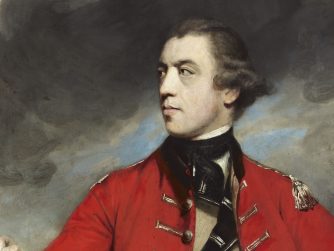
In October 1781, news of the British surrender at Yorktown reached Philadelphia, and crowds poured into the streets to celebrate. They looked for candles in their neighbors’ windows, which signaled that the household had supported their cause.
Anna Rawle refused to light a candle. Although she may not have considered herself a Loyalist, when the crowd approached her home, they began breaking her windows and bashing in her door.
In Episode 452, three scholars help us explore a question some Americans asked themselves at the time of the Revolution: How could they protect their families, property, and honor when neighbors, committees, and crowds decided what side they were on?
About the Show
Ben Franklin’s World is a podcast about early American history.
It is a show for people who love history and for those who want to know more about the historical people and events that have impacted and shaped our present-day world.
Episode Summary
 Timothy Compeau is an associate professor of history at Huron University College at Western University in Ontario. His research expertise is in the British Empire during the Age of Revolutions, Loyalists in the American Revolution, and the history of Upper Canada. He’s the author of the book Dishonored Americans: The Political Death of Loyalists in Revolutionary America.
 Bonnie Huskins teaches history at St. Thomas University in Fredericton, New Brunswick. Her courses include the history of the American Revolution, the history of loyalists, the British Atlantic World, and the history of Atlantic Canada. Her research interests include Loyalist community formation in New Brunswick, Nova Scotia, and Prince Edward Island, Loyalist Freemasonry, and the Untold Stories of Loyalist Women. She is the author of the articles “Shelburnian Manners: Gentility and the Loyalists of Shelburne, Nova Scotia” and “From a cosmopolitan fraternity to a loyalist institution: Freemasonry in British North America in the 1780s and 1790s.” She is currently finishing a book entitled An 18th Century Military Engineer in Britain’s Empire: The Entangled Life of William Booth.
 Kacy Tillman is a professor of English and writing and the director of the Honors Program at the University of Tampa. Her research expertise is in Loyalist women writers of the American Revolution and in early American sentimental fiction and romance. She’s written numerous articles and a book, Stripped and Script: Loyalist Women Writers of the American Revolution.
During our conversation, our guests reveal:
-
- How committees, crowds, and neighbors identified Loyalists
- How revolutionaries stripped Loyalist families of their honor
- Why historians now think more Loyalists stayed in the United States than left it
What You’ll Discover
- What made someone a Loyalist and why historians resist a single definition
- When the word “loyalist” entered common use and what Americans called them before that
- The misconception that Loyalists were wealthy, elite, and uniformly British
- Why Grace Galloway lost her home despite never calling herself a Loyalist
- How committees and crowds identified suspected Loyalists in their communities
- How crowd violence and the threat of assault shaped women’s daily fears during the war
- How Margaret Morris used wit and a trick bookcase to hide a fugitive Loyalist
- Hannah Ingraham’s childhood memories of property confiscation and exile to New Brunswick
- Where Loyalists found refuge in places like New York City, Niagara, and Detroit
- How Loyalists fought the war through militias, irregular raiders, and provincial regiments
- How tarring and feathering turned Thomas Brown from a reluctant bystander into a militia commander
- What happened to Black Loyalists who fled to Nova Scotia, London, and Sierra Leone
- Why weak language in the Treaty of Paris left most confiscated property in Patriot hands
- How class, family ties, and time shaped which Loyalists could reintegrate after the war
Links to People, Places, and Publications
- Timothy Compeau
- Bonnie Huskins
- Kacy Tillman
- Dishonored Americans: The Political Death of Loyalists in Revolutionary America
- Stripped and Script: Loyalist Women Writers of the American Revolution
- “Shelburnian Manners: Gentility and the Loyalists of Shelburne, Nova Scotia”
- “From a cosmopolitan fraternity to a loyalist institution: Freemasonry in British North America in the 1780s and 1790s“
- ‘The Book of Negroes’: Black refugees who fought in the American Revolution
- The Loyalist Collection at the University of New Brunswick
- Petition of loyalists from New York City, November 28, 1776
- Transcript
 Time Warp Question

In the Treaty of Paris of 1783, there is a provision that asks the United States to restore confiscated loyalist property, and it was provision that the states mostly ignored. But what if they hadn’t ignored it? In your opinion, what if the roughly 60,000 to 100,000 Loyalists who left the new United States had been able to return to or stay in their communities? What would their staying have meant for the new United States and for the history of Canada?
Complementary Episodes
🎧 Episode 085: American Loyalists in Canada
🎧 Episode 126: The Reintegration of American Loyalists
🎧 Episode 380: The Tory’s Wife
🎧 Episode 421: Loyalism and Revolution in Georgia
🎧 Episode 441: The Escapes of David George
Support Our Work
Love what you hear on Ben Franklin’s World? Support the show and help us keep history accessible, independent, and deeply researched. Make a tax-deductible donation at benfranklinsworld.com/donate.
Request a Topic
📨 Topic Request Form
📫 liz@benfranklinsworld.com
When You’re Ready
🗞️ BFW Gazette Newsletter
👩💻 BFW Listener Community
🌍 The History Explorers Club
Take the Quiz
🧭 Discover How You Explore History (under 2 minutes)
👉https://www.benfranklinsworld.com/quiz
Connect
🦋 Liz on Bluesky
👩💻 Liz on LinkedIn
🛜 Liz’s Website
Listen!
Enjoy the Podcast? Follow it!
 |

Say Thanks
💜 Leave a review on Apple Podcasts
💚 Leave a rating on Spotify
* All book links are for the Ben Franklin’s World Bookshop, the official affiliate bookstore of Bookshop.org. By purchasing a book with our affiliate links, you help support this podcast.